This story is part of The Untold Stories of the Golden Circle — a local’s living archive of the district.
On a summer afternoon the Golden Circle barely pauses. Rental cars and coaches run between Þingvellir, Geysir and Gullfoss, and many of them cross Grímsnes, the low district of lava fields and wetland that also holds Kerið crater.
Almost nobody in those cars knows that a fair distance from the main road, on a farm few people ever visit, stands a 1,400-square-metre concrete building that was meant to change how Reykjavík trained its young athletes. It never opened.
The Hidden Ghost Structure
The farm is called Reykjanes, and the name trips people up, so it is worth being plain about it. This is not the Reykjanes peninsula near Keflavík airport. It is a farm of the same name in Grímsnes, on flat, wet ground whose land reaches the spring-fed Brúará, the same river that pours through Brúarfoss.
When Morgunblaðið wrote about the building in 2020, its headline needed only one word for it: Kastalinn, the Castle.
The building has not been forgotten, exactly. When it comes up in conversation in Reykholt, on the Biskupstungur side of the river where I grew up, everyone knows it is there. What has been forgotten is its story. In its place, theories have grown: about rotten concrete, about demolition costs, about why nobody has ever been able to sell it. The newspapers of the time tell a different story, and a stranger one. It starts with hot water.
The 1987 Dream: Reykjavík’s Youth in Grímsnes
The dream is older than 1987. In 1969 Iceland’s national sports federation opened a sports centre at Laugarvatn, not far away, and it quickly became a favourite for team training camps. After only two summers, the Reykjavík Sports Union concluded that demand would outgrow it and that the city’s clubs needed a camp of their own.
A farm chosen for its hot water
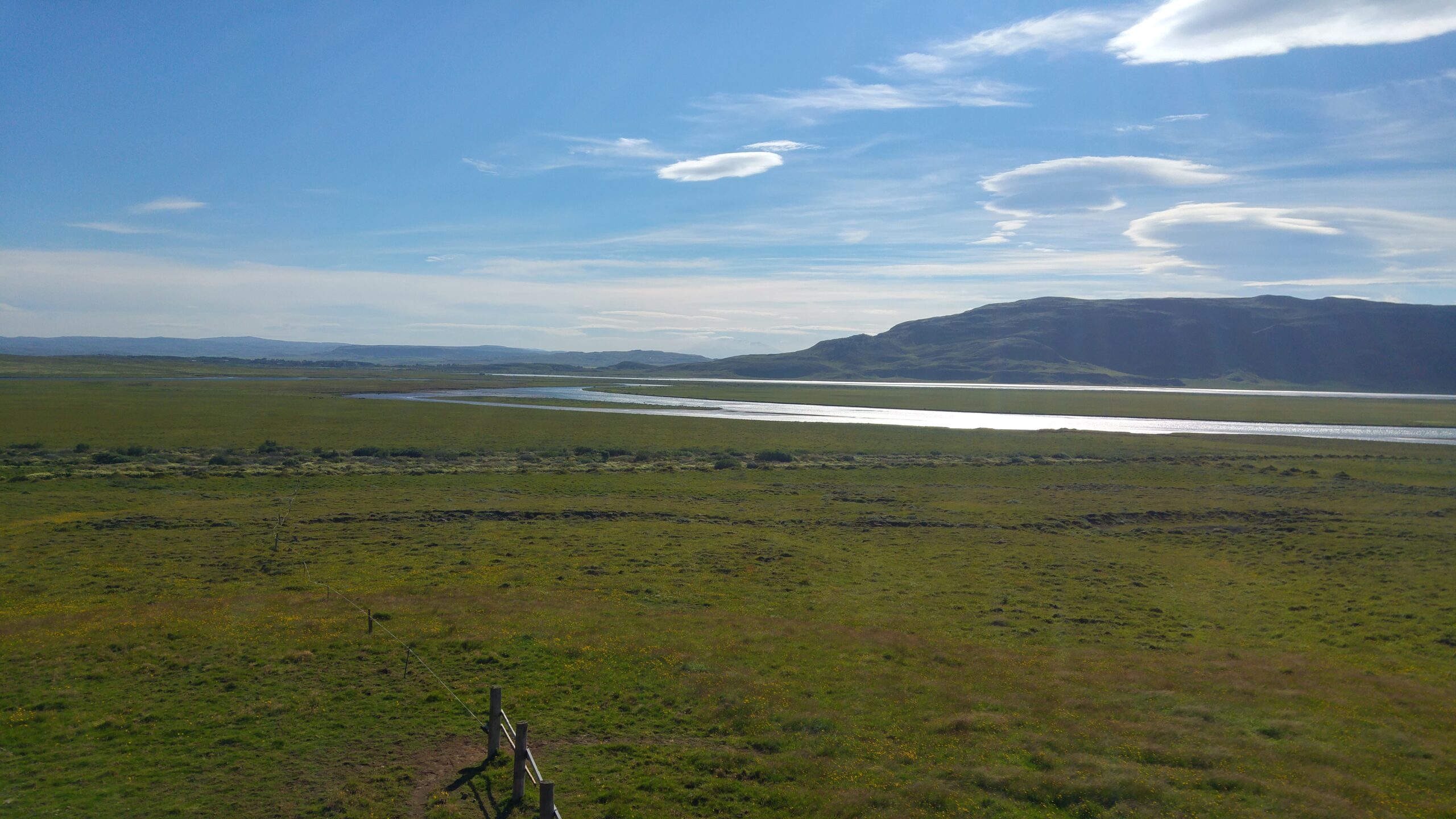
The flat, wet lowland around the site, July 2017.
In February 1971 Íþróttabandalag Reykjavíkur — ÍBR, the umbrella body for the city’s sports clubs — bought Reykjanes. That September its board invited Reykjavík journalists out to see the land: about 320 hectares (roughly 790 acres), flat and wet, some 100 kilometres (60 miles) from the city, with hot springs and pools giving around 30 litres a second of water at 70–90°C (158–194°F).
The heat was the whole point. ÍBR’s leaders told the press that a training centre with heated buildings and a swimming pool was practically unthinkable without geothermal water. Construction, they said, would hardly begin within two or three years. It took ten.
ÍBR’s own anniversary timeline, compiled in 2019, gives the purchase year as 1975. The papers of the day say otherwise: Morgunblaðið reported in September 1971 that the purchase had gone through that February, and in 1987 Tíminn wrote that ÍBR had owned the land for fifteen years.
What was actually built
The plan was a complete training centre: playing fields, a sports hall, a swimming pool, and a main building where visiting teams would sleep and eat. ÍBR applied for state support in 1971 and received a building permit in 1980. The concrete went up between 1981 and 1983.
This is the detail that keeps getting lost: what stands at Reykjanes was never a sports hall. Tíminn described it in 1987 as a 1,400-square-metre building (about 15,000 square feet) meant for accommodation, dining and meeting rooms, the residential heart of a youth camp. The pitches were to go on the slope below it, where the wet ground had already been largely drained. The sports hall, the pool and the playing fields were never built. Even a 2020 newspaper headline called the building a sports palace. It was always a lodge.
How much went into it? ÍBR never published a full tally. What the record does show is where some of the money came from. In 1981 the city of Reykjavík bought ÍBR’s 8 percent share in Laugardalshöll, the capital’s big indoor arena, and most of the proceeds went to Grímsnes. The figure that would decide the building’s fate came later.
The headline of August 1987
By the summer of 1987 the concrete had stood silent for four years. On 6 August, Tíminn gave the story its back page under a headline full of confidence: Reykvíska æskan mun skokka í Grímsnesinu — Reykjavík’s youth will go jogging in Grímsnes.
That was the promise. There were signs, the article began, that Reykjavík’s athletes would have a complete sports centre in Grímsnes in the coming years, and the photo caption imagined the city’s young sportspeople staying there for training camps in fine comfort.
Read on, and the story underneath was different. Little had been done for three years. The roof was on, the concrete had been treated with silane, a water-repellent coating against concrete damage, and drains had been laid around the building, but it was still a closed-in shell. ÍBR’s chairman, Júlíus Hafstein, told the paper he could not say what the site’s future would be. The question had come up at ÍBR’s last general assembly and been postponed. He expected a decision at the next one, and said it was no secret that individuals and organisations had shown considerable interest in the property.
Then a second caption gave the game away. The ground floor, it noted, had already been taken into use by the horses of Grímsnes, whose droppings lay across the floors.
The headline promised jogging teenagers. The countryside had already moved in.
The Local Memory: When the Money Stopped
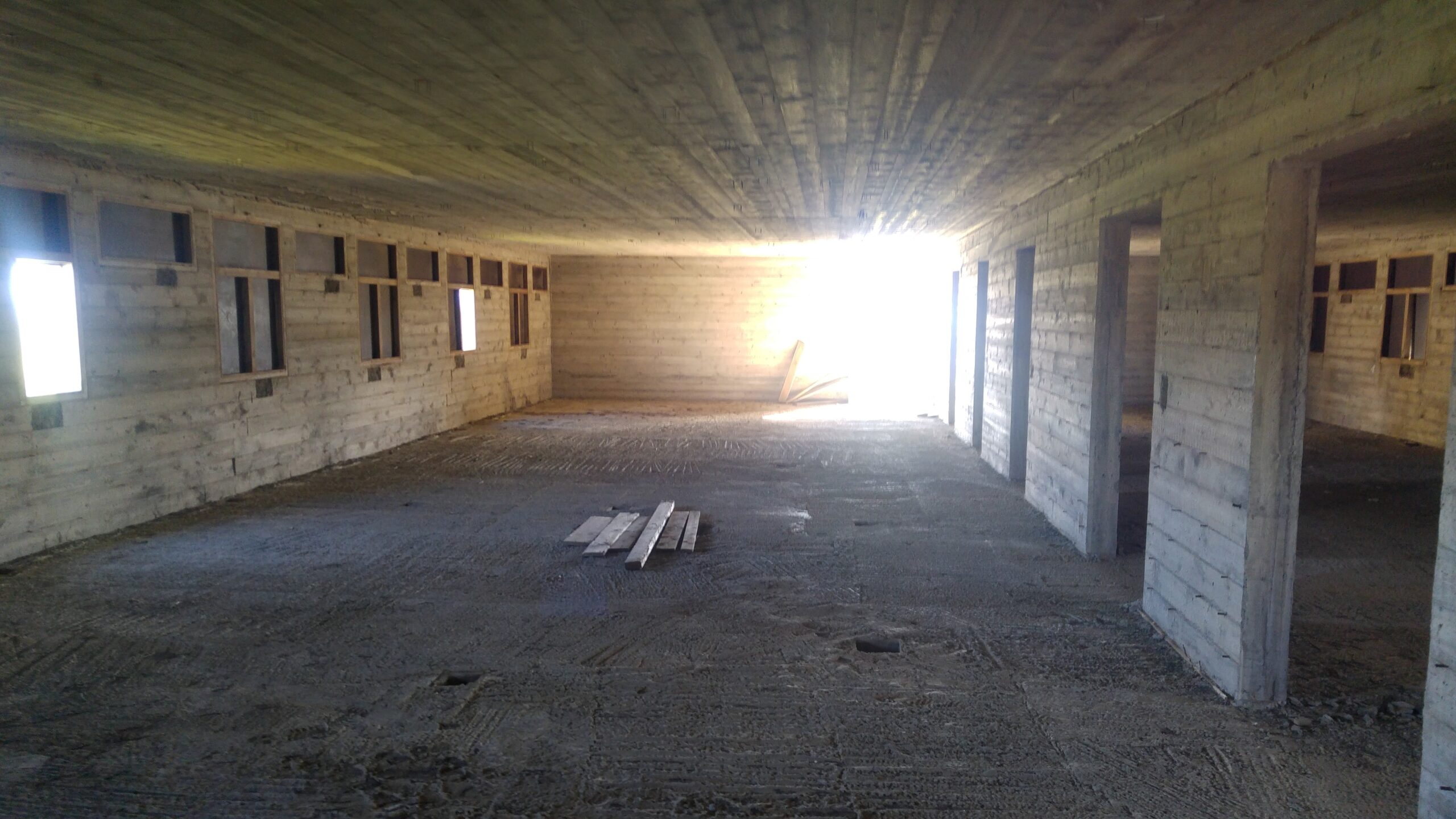
One of the long corridors, July 2017.
Seen from Reykjavík, Reykjanes was a promise to the city’s young athletes. Seen from the farms around it, it was something else: a city organisation’s building site on a local farm, its future decided at meetings in town. Even Tíminn admitted in 1987 that the project had never made much noise.
When the money stopped, it did not stop with a bang. ÍBR’s own history says inflation and a shortage of money dogged the project from its first day, and Iceland’s inflation in those years was ferocious. In 1983, the year work on the building ended, consumer prices rose by about 84 percent, the highest annual rate in the World Bank’s records for Iceland.
The end came on paper. Some time after the work stopped, ÍBR had the investment reviewed. Its managing director later told Morgunblaðið what the review found: given the total investment and the cost of getting started, the centre could not be expected to pay its way. Finishing the building and the sports facilities was estimated, at 1986–87 prices, at roughly five to six million US dollars at the exchange rates of the day, well over ten million in today’s money. The board decided to put the building and the land up for sale.
The Ruin Today
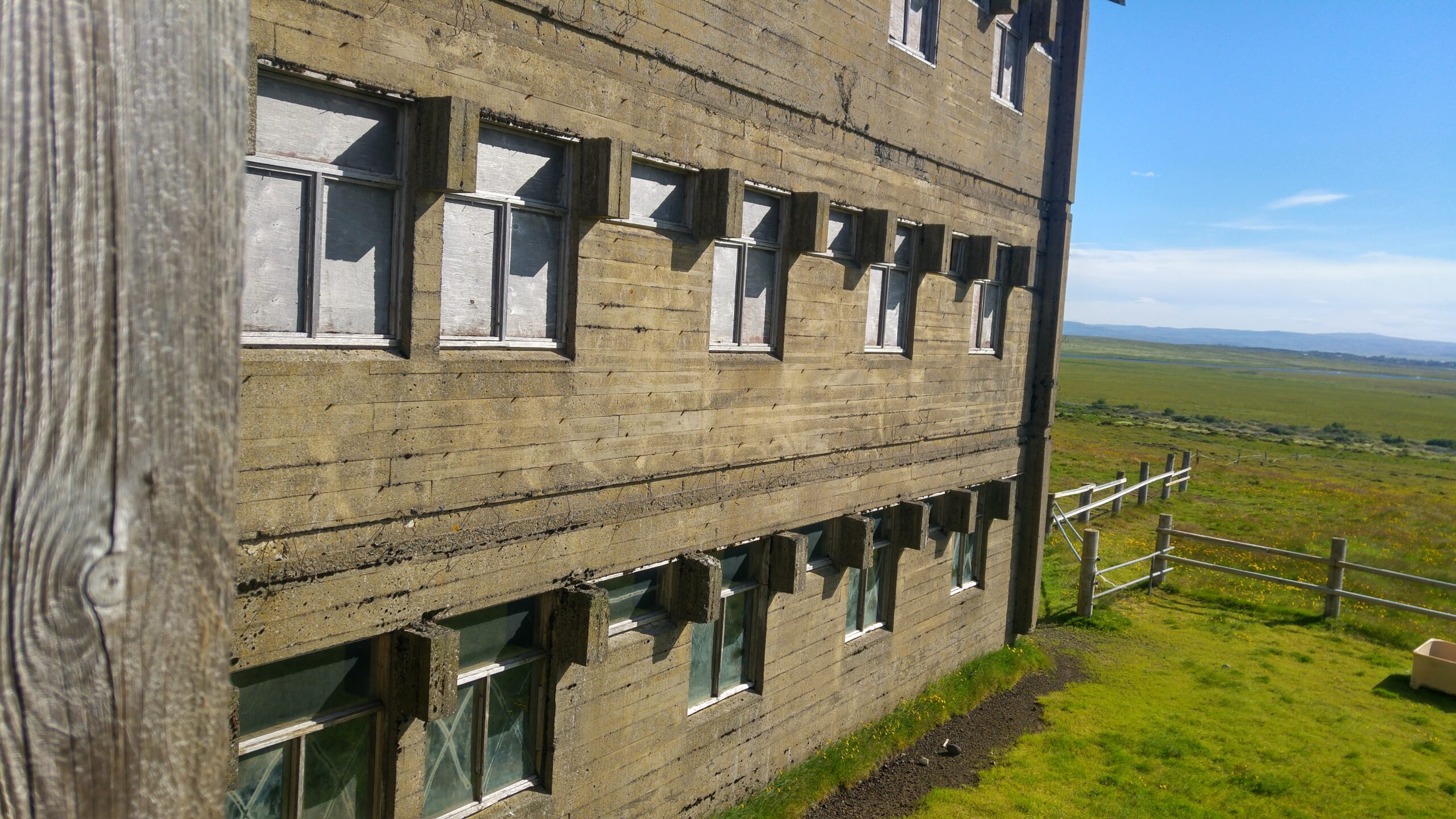
Deep-set windows along the facade, July 2017.
When these photographs were taken, on a bright morning in July 2017, the building looked less like a ruin than like a building site that had been paused and never resumed. Long corridors of bare concrete run the length of the floors, and the grain of the timber formwork is still printed sharp on the walls and ceilings. The floors are gravel and packed earth. Window frames sit in some openings and are missing from others, and at the far end of a corridor the daylight pours in through an opening.
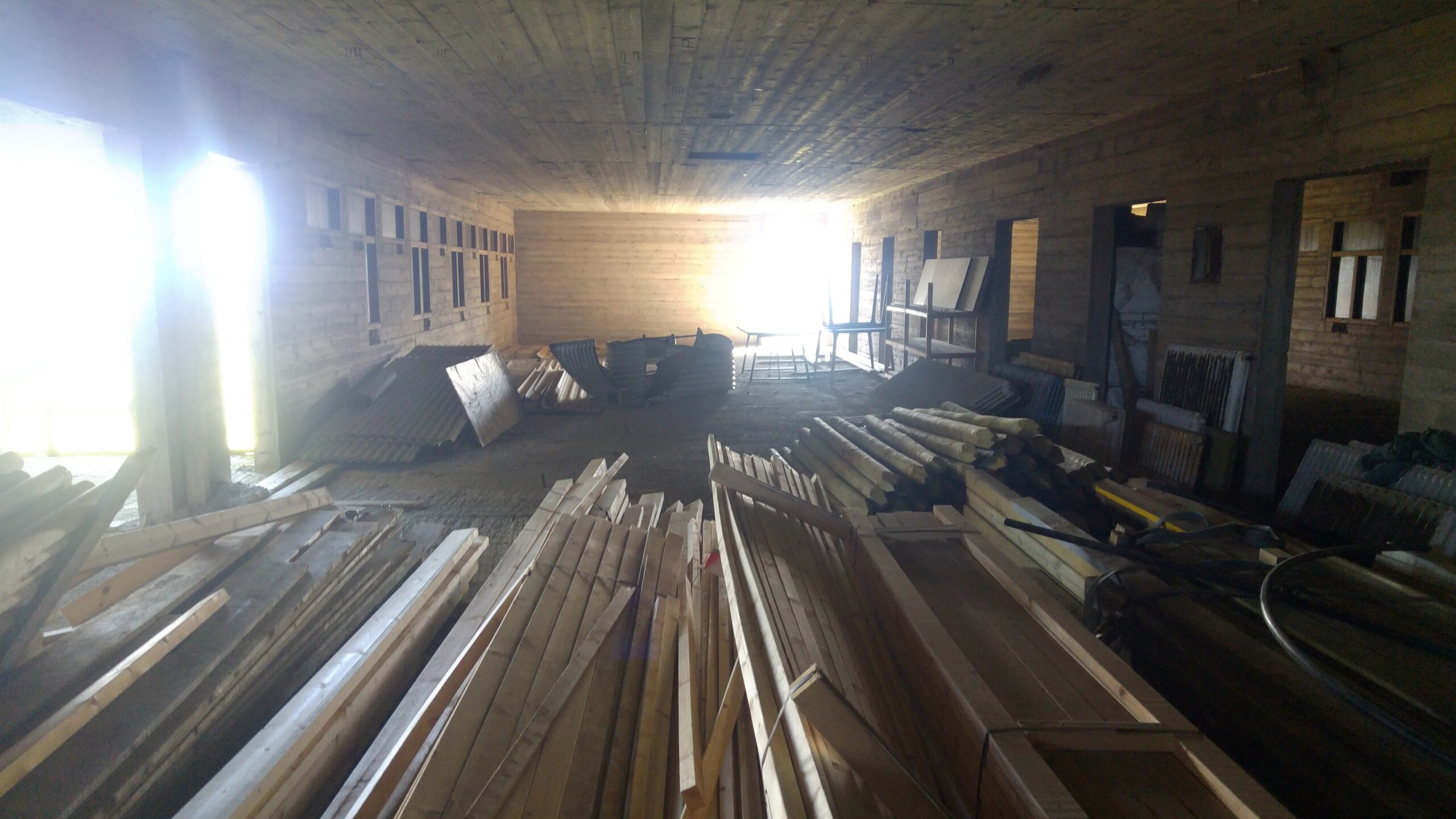
Stacked timber inside the building.
Inside lie stacks of timber, piles of insulation board, plastic tubs and sheets of corrugated metal. On the ground floor the earth is soft underfoot, and a wide doorway opens straight onto a fenced pasture. Outside, rows of deep-set windows run along the concrete facade, looking out over flat green wetland and the glint of water in the distance.
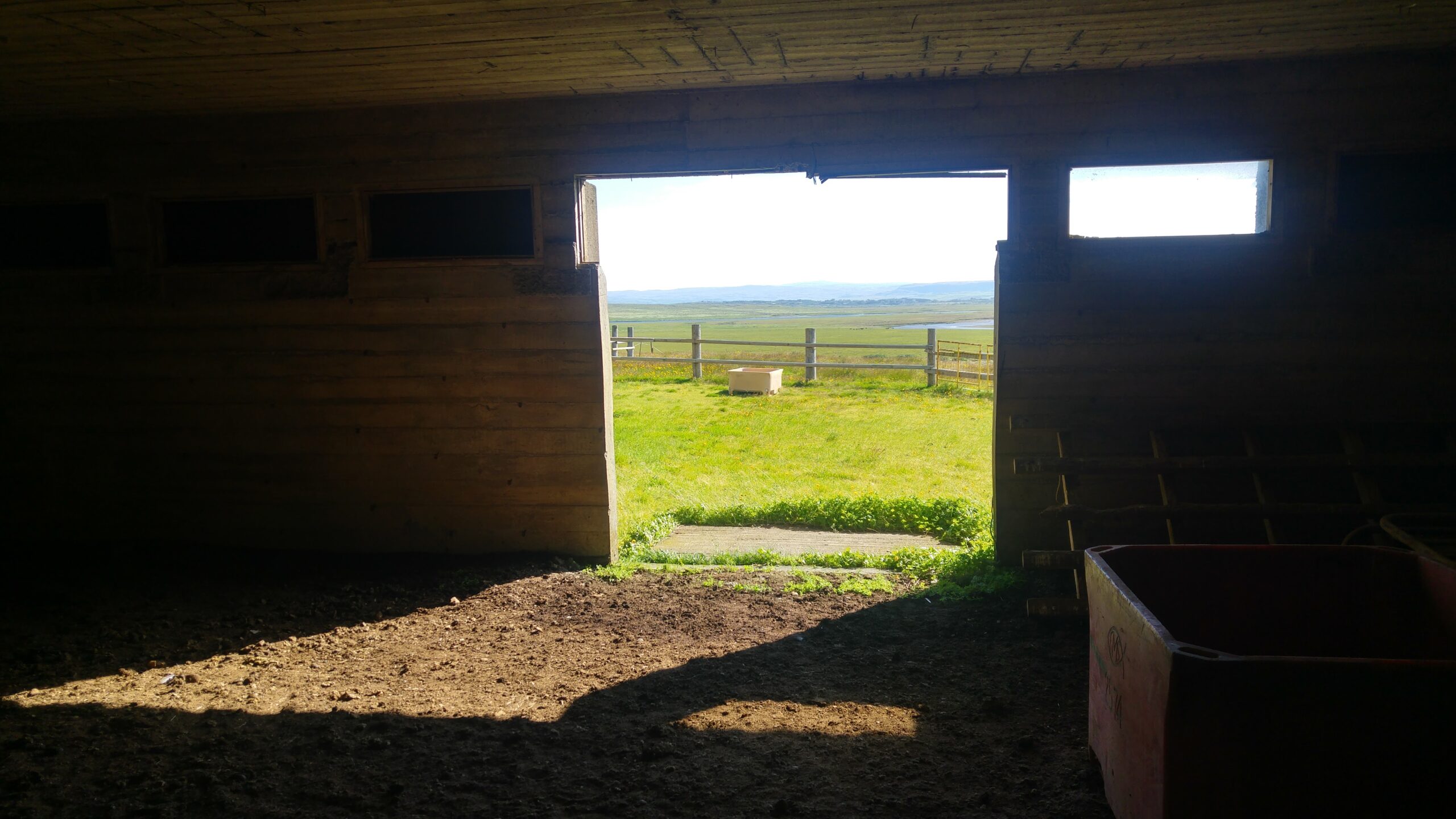
A ground-floor doorway onto the pasture.
It is eerie in the way only an unfinished building can be. A ruin has had a life. This one never got to begin. It never opened for the camps it was built for, and the pitches meant to lie below it were never laid. Whatever the headlines have called it, this sports palace never hosted a single game.
The weather has had more than forty years to work on it. In 1996, ÍBR’s managing director insisted there was no concrete damage in the building and that the roof was sound, though he admitted it had often been broken into and that animals had taken shelter inside. When Morgunblaðið visited in 2020, it described the building as open to the weather, a long way from the main road and rarely visited.
A word to anyone tempted to go looking: Reykjanes is private land, in use by its owners. The building is not open to visitors, and an unfinished shell is no place to explore. This is a story best enjoyed from a distance.
The Fortress Nobody Finished
When the building comes up in Reykholt, the conversation always lands on the same question: why has nobody ever been able to sell it? The theories follow close behind:
- that forty winters of frost have got into the concrete and rusted the steel inside it, so the whole thing would have to come down to its foundations;
- that pulling down that much reinforced concrete would cost more than the land is worth, so any developer would sooner buy the empty field next door;
- that it was built as a giant sports hall, the wrong shape for a hotel and too big for any farmer;
- and that the municipality once talked of simply blowing it up.
They are good stories. The paper trail answers most of them, and its answers make the mystery deeper, not shallower.
It did sell
In September 1996 ÍBR advertised the shell together with about 270 hectares (some 670 acres) of geothermal land and fishing rights in the Brúará, for about $240,000 in cash at the time, roughly half a million dollars in today’s money. Its managing director, Kolbeinn Pálsson, admitted the earlier asking price had perhaps been set too high. He said there had been considerable interest that summer, and quite a few offers from individuals and organisations. In 2020 Morgunblaðið reported that private owners had bought Reykjanes more than twenty years earlier and that they use the land. The building, the paper said, has been a side issue.
The concrete
The concrete theory is the one the record cannot settle, but it is not the one the record supports. In 1996 the seller stated plainly that there was no concrete damage and that the roof was sound. A seller has every reason to say so, of course, but it remains the only first-hand statement on record. The shell had been treated with silane in the 1980s precisely to protect it, and in 2017 the formwork grain was still crisp on its walls. No engineering assessment has been published since. Whether the frost has finally won is a question for an engineer with a core drill, not for a newspaper or a website.
The wrong building
The “wrong building” theory is the opposite of the truth. The block was designed for exactly what people imagine it could become: beds, a dining room, meeting rooms. In 1996 ÍBR said many people thought it could serve all sorts of purposes, being close to the highlands for summer and winter trips. Kolbeinn pointed to about 80 hectares (some 200 acres) nearby that suited summer houses, and said that when they drilled for hot water they had to go only five metres (16 feet) down. Ideas have come and gone since: a monastery, a retirement home, and a peace centre that the businessman Ástþór Magnússon wanted to run there. As for being too big for any farmer, the local horses had moved into the ground floor before Reykjavík had decided what to do with it.
The explosives
That part is real, as far as it goes. A note filed with Morgunblaðið’s photographs of the building in 2020 records that blowing it up had been discussed. By whom, and how seriously, it does not say.
So the real mystery is not why nobody could sell it. Somebody did. It is why a lodge built for precisely the use everyone imagines, on land where hot water lies five metres down, just off Iceland’s most famous tourist route, has stood unfinished since 1983, through the tourism boom and beyond it. The public record does not say.
The Legal Question
People also say the paperwork is a nightmare: that a Reykjavík organisation’s project on rural Grímsnes land left behind a tangle of ownership and zoning that no developer wants to touch. The record does not bear that out. ÍBR bought the farm in 1971 and sold it in the late 1990s, and nothing in the records we have found suggests the Reykjavík connection left anything behind but the concrete.
What the record does show is that Reykjanes has never been a blank sheet. A 15-hectare (37-acre) parcel of the farm, the greenhouse holding known as Reykjalundur, has been held on a hereditary lease since 1939, more than thirty years before ÍBR arrived. In 2000 the municipality approved a local plan for fourteen summer-house plots on Reykjanes land, and some were built. When the municipal plan was revised for 2008–2020, that summer-house area was designated as farmland. The planning committee concluded in 2013 that this had been a mistake, and the council moved to restore it. Along the way, the national planning agency noted that the area was on Iceland’s nature conservation register. That same year, two of the farm’s owners appealed a planning decision for the greenhouse holding to Iceland’s Environmental and Natural Resources Board of Appeal. The board rejected the appeal in 2015, noting that disputes over property rights were outside its remit.
None of that proves paperwork is what froze the building. The appeal concerned the greenhouse holding, not the old ÍBR block. But it does show why “just buy it and turn it into a hotel” is never as simple as it sounds. Any new use would have to go through the municipality’s planning process, on land with a long and layered history.
A Monument to 1980s Ambition
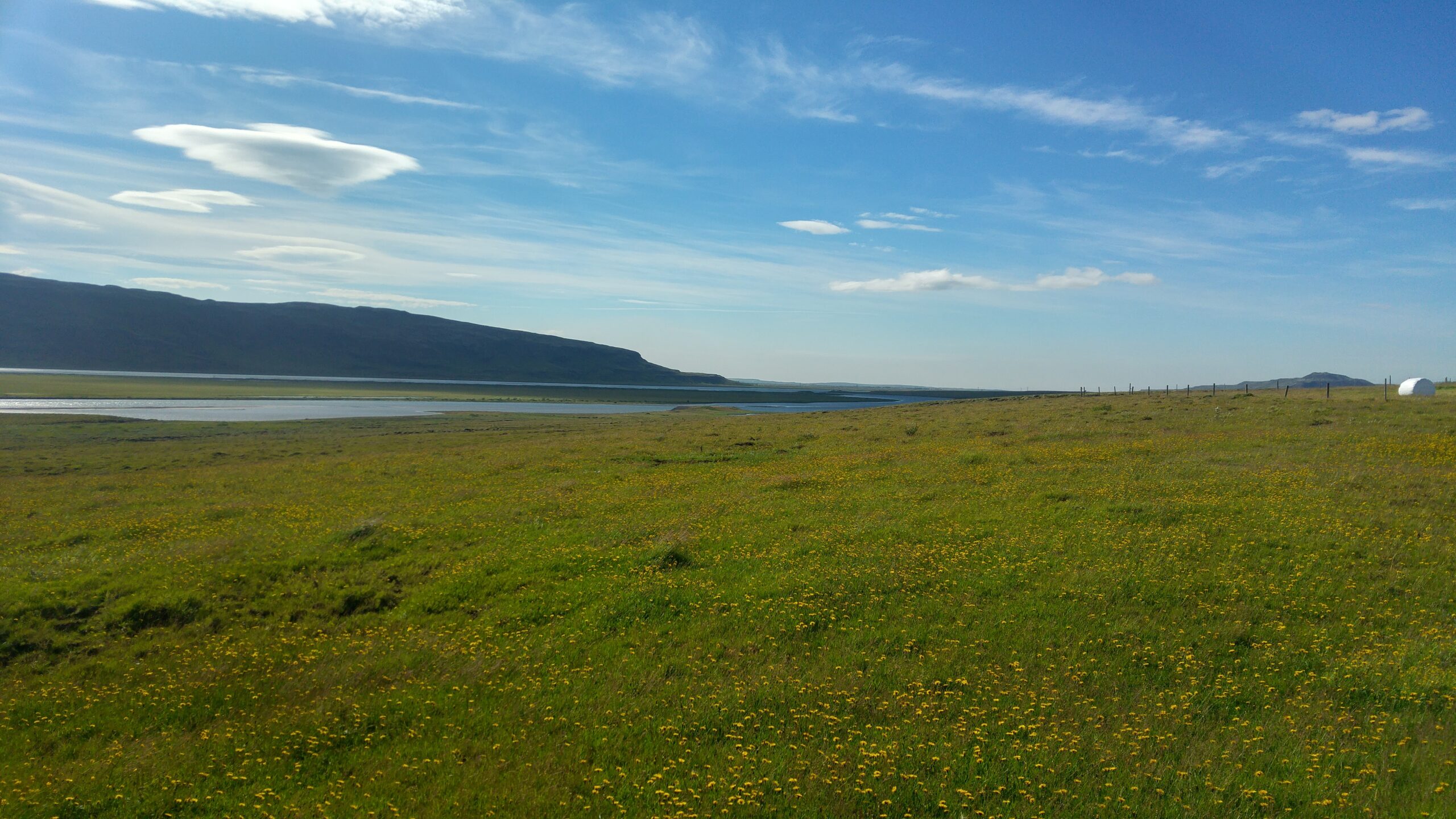
Looking out from the site, July 2017.
Every era leaves something in this landscape. The twentieth century left power stations on the Sog, summer houses across the lava fields and, at Geysir, the 1963 drilling that brought Strokkur back. Reykjanes is what the early 1980s left behind: a plan born in 1971, poured in concrete in the inflation years, then reviewed, priced and quietly let go.
In August 1987 a newspaper promised that Reykjavík’s youth would go jogging in Grímsnes. They never came. The horses came, and the weather, and the summer houses, and the stories told in Reykholt about rotten concrete, ruinous demolition bills and a building nobody could sell. Most of those stories are wrong. The question underneath them is not: why has nothing been done with it?
Until someone answers that, it stands where it has stood since 1983, roofed, walled and waiting: a concrete time capsule of 1980s ambition, resting quietly just off Iceland’s most famous tourist route.
More from the archive: Peningagjá, the Money Fissure at Þingvellir · a local history of Gullfoss and the Hvítá · Brúarfoss, the waterfall that was a road · all the Untold Stories of the Golden Circle.
Common Questions
What is the abandoned building at Reykjanes in Grímsnes? It is the unfinished main building of a training centre that Íþróttabandalag Reykjavíkur (ÍBR), the umbrella body for Reykjavík’s sports clubs, began building in 1981. The 1,400-square-metre concrete block was meant to house visiting teams, with accommodation, dining and meeting rooms. Work stopped in 1983, and it never opened.
Was it a sports hall? No. The building that stands was designed as the camp’s lodge. The sports hall, swimming pool and playing fields planned around it were never built, even though later headlines called it a sports palace.
Why was it never finished? Inflation and a shortage of money dogged the project from the start: Iceland’s consumer prices rose about 84 percent in 1983, the year work stopped. A later review for ÍBR found the centre could not be expected to pay its way, and finishing it was estimated at roughly $5–6 million at 1986–87 exchange rates. ÍBR then decided to sell.
Who owns it today? ÍBR advertised the building and about 270 hectares of land for sale in 1996. According to Morgunblaðið, private owners bought the Reykjanes property in the late 1990s and use the land; the building has been a side issue.
Can you visit the building? No. Reykjanes is private land in use by its owners, the building is not open to visitors, and an unfinished concrete shell is not a safe place to explore.
Is it on the Reykjanes peninsula? No. Reykjanes in Grímsnes is a farm in the Golden Circle area of South Iceland, on land that reaches the Brúará river. It has nothing to do with the Reykjanes peninsula near Keflavík airport.
Will the building be demolished? Nothing had been decided when Morgunblaðið reported on the building in 2020, although the paper’s photo notes record that blowing it up had been discussed. Ideas for reusing it over the years have included a monastery, a retirement home and a peace centre.
When did ÍBR buy Reykjanes? In February 1971, according to Morgunblaðið’s report that September. ÍBR’s own 2019 anniversary timeline gives the year as 1975, but the contemporary reports contradict it.
Sources
Tíminn, “Reykvíska æskan mun skokka í Grímsnesinu”, 6 August 1987, p. 20. The 325 hectares owned for fifteen years, the 1,400-square-metre lodge begun seven years earlier, the planned pitches, the three years of little work, the roof, silane and drains, Júlíus Hafstein’s comments, and the horses on the ground floor.
Morgunblaðið, “ÍBR kaupir Reykjanes í Grímsnesi”, 10 September 1971, p. 30. The February 1971 purchase, the size and setting of the farm, the hot springs, and why geothermal heat was essential to the plan.
Morgunblaðið, “ÍBR vill selja fokhelda 1400 fermetra byggingu í Grímsnesi”, 4 September 1996, p. 9. The 1971 grant application, the 1980 permit and 1981–83 construction, the review of the investment, the 1986–87 completion estimate, the sale, and Kolbeinn Pálsson’s account of the building’s condition.
Sigurður Bogi Sævarsson, “Kastalinn verið fokheldur í áratugi”, Morgunblaðið, 27 July 2020, summarised on mbl.is as “Íþróttahöll yfirgefin í áratugi”. The building’s state in 2020, its sale to private owners, and the ideas for its reuse. Caption notes filed with the paper’s photographs of 25 July 2020 record the discussion of blowing it up.
Íþróttabandalag Reykjavíkur, “Saga íþrótta í Reykjavík”, timeline compiled by the historian Stefán Pálsson for ÍBR’s 75th anniversary, 2019. The Laugarvatn background, the money troubles, and the 1981 sale of ÍBR’s share in Laugardalshöll.
Úrskurðarnefnd umhverfis- og auðlindamála (Environmental and Natural Resources Board of Appeal), case 110/2013, ruling of 12 November 2015. The hereditary lease on Reykjalundur, the 2000 summer-house plan, the planning error and the conservation listing.
World Bank, World Development Indicators: consumer price inflation for Iceland. Dollar figures are approximate, converted at the average exchange rate of the year in question and adjusted with US consumer prices for today’s money.
The photographs were taken on 27 July 2017 and are from the author’s collection. How the building is talked about in Reykholt is local knowledge from the author.