Trigger Warning: The following article contains historical descriptions of violence, torture, and executions from Iceland’s medieval and early modern periods. Reader discretion is advised.
This story is part of The Untold Stories of the Golden Circle — a local’s living archive of the district.
The Tourist Illusion
Stand on the footbridge where the Öxará river spills east out of Almannagjá on any summer afternoon and count the phones. Couples lean on the railing with the white water behind them. A tour group waits its turn for the same frame. Someone films the river foaming over the rocks, then walks on toward the car park.
Very few of them look down.
The pool beneath that bridge is Drekkingarhylur, the Drowning Pool. Between 1618 and 1749, at least 18 women were put into sacks and pushed into this water. They were held under with a pole until they stopped struggling. The bridge stands almost exactly where the executioners stood.
Many English-language accounts place this scene at Öxarárfoss, the tall waterfall further up the gorge. That is the wrong waterfall. Öxarárfoss is where visitors go to admire the river. The place where the river was used to kill is downstream, at a lower fall that older Icelandic sources call Neðrifoss, right under the bridge everyone crosses on the way back to their bus.
A parliament that also kept the axe
Þingvellir is sold as the birthplace of Icelandic democracy, and it is. It was also where the Alþingi carried out its own sentences. Icelandic legal historian Páll Sigurðsson counts 72 people executed here after formal judgment. Archaeologist Steinunn J. Kristjánsdóttir’s list of executions names 75, and 55 of them were men.
None of those sites has a gate, a fence or a ticket desk. Two of them sit beside the most-walked paths in the park. One lies partly under a road. Most visitors pass all four in a single afternoon without knowing it.
Stóridómur: The Great Judgment of 1564
The killing at Þingvellir did not begin with the Vikings. The Commonwealth law code, Grágás, had no death penalty at all. Its harshest sentence was full outlawry. The state that later carried out executions at the Alþingi was a different creature: royal, Lutheran and, after the Reformation of 1550, determined to police the private lives of its subjects.
Who actually wrote it
English summaries often say the Danish king imposed Stóridómur on Iceland. The document itself tells a different story. The National Archives of Iceland hold a copy written around 1635, and it opens with the names of 24 Icelandic men who sat in judgment at the Alþingi on Friday, 30 June 1564. They acted at the request of the king’s governor, Páll Stígsson, and the two lawspeakers. King Frederick II confirmed the judgment a year later. Icelanders sat in judgment over Icelanders.
The judges wrote down their reason. They pointed to the óhæfa og fordæðuskapur, the abomination and wickedness, that befell so many people „ár eftir ár, mest sökum hegningarleysis“: year after year, mostly for lack of punishment.
What the law actually said
The old church law listed seventeen degrees of kinship and marriage within which sex was forbidden. Stóridómur made every one of them a capital crime. In the judges’ own words, those who broke it:
„skulu falla til óbótamála og hafa fyrirgjört lífinu, karlmenn höggvist en konur drekkist“
(shall be beyond atonement and have forfeited their lives, the men to be beheaded and the women drowned)
Half of the condemned person’s property went to the king. The other half went to their heirs, the text says, „sakir fátæktar landsins“, because the country was poor.
Below the death penalty ran a ladder of fines, and the ladder was built for the poor to fall off. More distant relatives paid fines for a first offence, then lost „húðina“, their skin, meaning a public flogging, if caught again. Anyone who could not pay took two strokes of the rod for every mark they owed. Unmarried parents paid a rising fine for each child together and were flogged at the fifth. Married people caught in adultery a third time received the same sentence as incest: the men to lose their heads, the women to be drowned.
The National Archives’ own commentary adds two facts English accounts usually leave out. The fines that used to go to the Church now went to the king’s agent, which made the law a real source of royal income. And the harshness of the law sometimes drove women to hide a pregnancy and let the newborn die, the crime that would later fill the Drowning Pool.
One crime, two deaths
The law split its punishment by sex. A man convicted of the worst offences was taken to Höggstokkseyri, the Block Spit, a gravel bank in the Öxará where the executioner’s block stood, and beheaded. A woman convicted of the same act was taken to Drekkingarhylur, put into a sack and drowned.
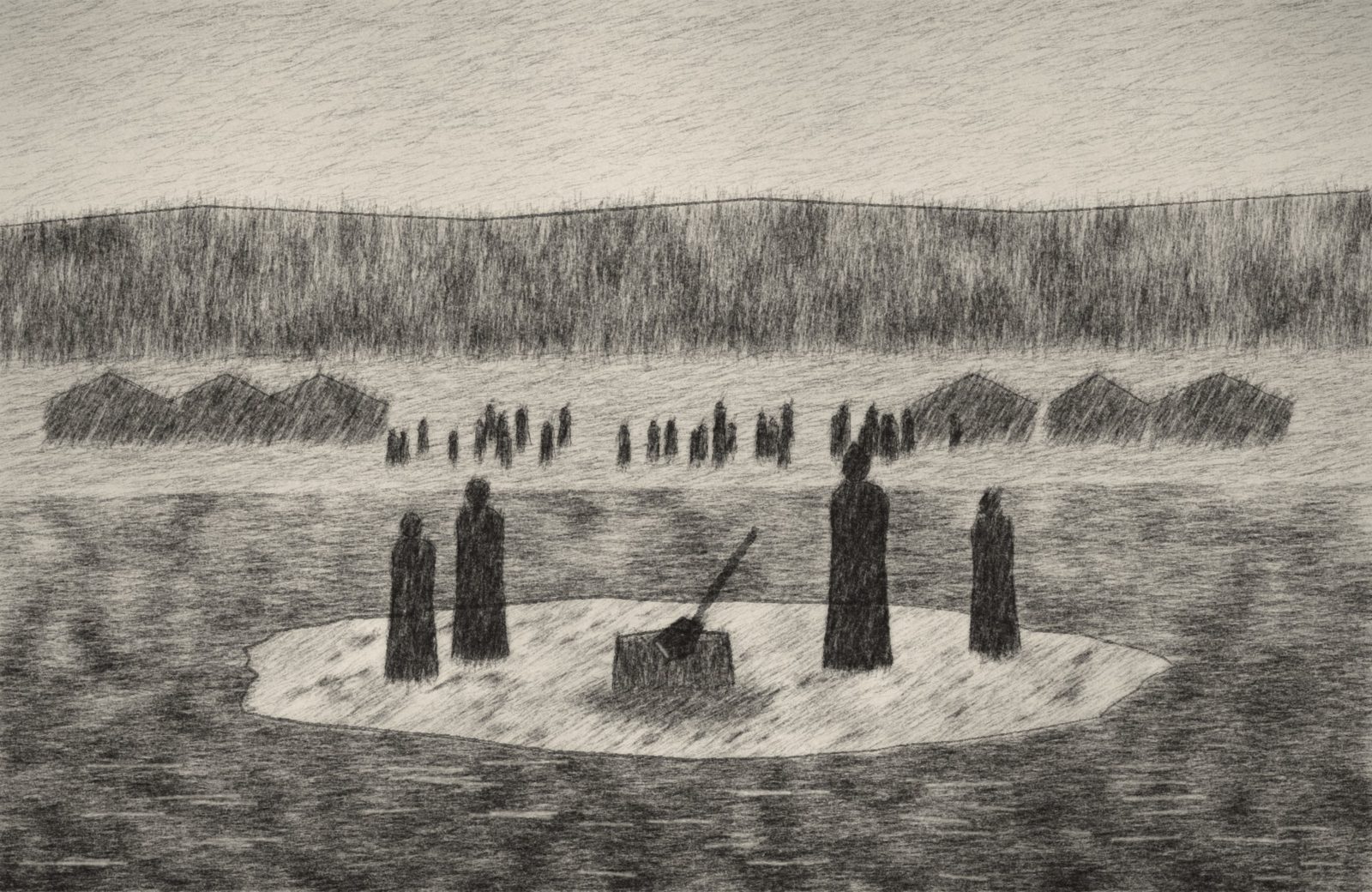
Höggstokkseyri: the gravel bank in the Öxará where the block stood, with the assembly’s booths behind.
The National Park’s own records note that drowning sentences under Stóridómur were not carried out until 1590, a generation after the law passed. Once the machinery started, it ran for roughly 160 years. Páll Sigurðsson dates the executions at Þingvellir from 1602 to 1752, when the last person put to death there was beheaded.
The executed were almost always buried close to where they died, without ceremony and without the church. Höggstokkseyri itself no longer exists as a gravel bank. The river has shifted its channels over the centuries, and the spot most likely lay on an islet off the mouth of Brennugjá that is now overgrown with grass.
The Roll of the Dead: 75 Executions at the Alþingi
The Drowning Pool gets the plaque, but most of the people executed at Þingvellir were men. Archaeologist Steinunn J. Kristjánsdóttir at the University of Iceland has compiled every recorded execution in Iceland, 236 of them between 1550 and 1830, each traced to the annals and the published Alþingisbækur. Seventy-five of those entries name the Alþingi as the place of execution. Of the 75, 55 were men and 20 were women.
- 42 died under the sexual laws or for hiding a birth: incest, adultery, “debauchery”, or a newborn found dead.
- 16 were hanged for theft. Another man was hanged for adultery.
- 9 were executed for murder.
- 8 were burned for sorcery.
By method, the list records 21 beheadings, 17 hangings, 17 drownings and 8 burnings. For 12 more, it says only that the person was “taken from life”.
Who they were
The youngest was Sigurður Skúlason, 17, hanged for theft in 1697 alongside Jón “Gráni” Jónsson, who was 20. The oldest was Sigmundur Guðmundsson of Klúka in the Strandir district, 80 years old, beheaded in 1738 on the same day his 36-year-old daughter Halldóra was drowned. Lassi Diðriksson was 70 when he was burned.
They were farm servants, tenant farmers, a fisherman, a housekeeper, a vagrant. In 1703 four men were hanged at one Alþingi, and one of them, Jón Þórðarson, for theft and vagrancy together. In 1705 three men were beheaded for incest at a single Alþingi.
Families died together. A stepfather and stepdaughter in 1639, again in 1647, again in 1650. An aunt and her nephew in 1618. A father and daughter in 1738. A widow and her dead husband’s brother in 1749.
Worse than death
Two men on the list were punished beyond the sentence of death. Guðmundur Narfason, a farmer from Kílhraun on Skeið, was beheaded for murder in 1650, his body cut apart and his head set on a pole. The last person executed at Þingvellir, Jón Jónsson of Bær in Hrútafjörður, known as Kjöseyrar-Jón, was beheaded for murder in 1752. Before the axe fell, he was pinched with glowing tongs. His head, too, was set on a pole.
The full roll
Year · name, age and home district where recorded · crime · how they died.
1602 · Björn Þorleifsson, 47, Snæfellsnes · Debauchery · Beheaded at Höggstokkseyri
1606 · Bjarni Hildibrandsson, 31 · Incest · Executed
1618 · Þórdís Halldórsdóttir, 43, Sólheimar, Skagafjörður · Incest · Drowned
1618 · Guðbjörg Jónsdóttir, East Iceland · Incest with her nephew · Drowned
1618 · Unnamed man, East Iceland · Incest with his aunt · Beheaded
1624 · Hildibrandur Ormsson, 44, Dýrafjörður · Incest with his wife’s sister · Executed
1624 · Sesselja Jónsdóttir, 29 · Incest with her sister’s husband · Executed
1639 · Unnamed woman, Eyjafjörður · Incest with her stepfather · Drowned
1639 · Unnamed man, Eyjafjörður · Incest with his stepdaughter · Beheaded
1641 · Helgi Þorgeirsson, 56, Strandir · Adultery · Executed
1647 · Jón Þorsteinsson, 47, Húnavatnssýsla · Incest with his stepdaughter · Executed
1647 · Björg Andrésdóttir, 22, Húnavatnssýsla · Incest with her stepfather · Executed
1650 · Guðmundur Narfason, 50, Kílhraun, Skeið · Murder · Beheaded, dismembered, head on a pole
1650 · Jón Jónsson, Snæfellsnes · Incest with his stepdaughter · Beheaded
1650 · Sigríður Einarsdóttir, Snæfellsnes · Incest with her stepfather · Drowned
1667 · Þórarinn Halldórsson, 42, Westfjords · Sorcery · Burned in Almannagjá
1671 · Sigurður Jónsson, Vatnsfjörður · Sorcery · Burned
1673 · Bjarni Sveinsson, 38, Þingeyjarsýsla · Incest with his wife’s sister · Executed
1674 · Páll Oddsson, Vatnsnes · Sorcery · Burned
1674 · Böðvar Þorsteinsson, 39, Gufuskálar · Sorcery · Burned
1675 · Lassi Diðriksson, 70, Rauðasandur · Sorcery · Burned
1677 · Bjarni Bjarnason, 62, Önundarfjörður · Sorcery · Burned
1677 · Þorbjörn Sveinsson, 37, Borgarfjörður · Sorcery · Burned
1678 · Eyvindur Jónsson, 38, Ölfus · Adultery, living as an outlaw · Beheaded
1678 · Margrét Símonardóttir, 38 · Adultery, living as an outlaw · Drowned
1680 · Sæmundur Þorláksson, 25, Fljótshlíð · Incest with his cousin, hidden birth · Beheaded
1681 · Þorkell Sigurðsson (“Lyga-Þorkell”) · Theft · Hanged
1681 · Þorgeir Ingjaldsson, 51, Árnessýsla · Adultery · Hanged
1681 · Ari Pálsson, 51, Arnarfjörður · Sorcery · Burned
1682 · Jón Pétursson, Westfjords · Theft · Hanged
1682 · Jón Þorsteinsson, Skutulsfjörður · Murder · Beheaded
1683 · Helga Gunnarsdóttir, 33, Hrútafjörður · Incest · Drowned
1683 · Vilkin Árnason · Theft · Hanged
1684 · Guðrún Jónsdóttir, 29, Bessastaðir · Hidden birth · Drowned
1684 · Sigvaldi Jónsson, 24, Rangárvallasýsla · Murder · Beheaded
1686 · Jón Þorláksson, Norðfjörður · Hidden birth · Beheaded
1687 · Borgný Brynjólfsdóttir, 47 · Incest · Drowned
1693 · Unnamed man, Múlasýsla · Theft (probably) · Hanged
1695 · Þuríður Bjarnadóttir, 25, Bolungarvík · Hidden birth, incest · Drowned
1697 · Jóreiður Þorgeirsdóttir, 32, Ölfus · Hidden birth · Drowned
1697 · Jón Jónsson (“Gráni”), 20 · Theft · Hanged
1697 · Sigurður Skúlason, 17 · Theft · Hanged
1697 · Ólafur Brandsson, Saurbær, Dalir · Murder · Beheaded
1697 · Þorsteinn Þorleifsson, Saurbær, Dalir · Murder · Beheaded
1699 · Jón Sigmundsson, Snæfellsnes · Theft · Hanged
1700 · Andrés Þórðarson, Borgarfjörður · Theft (probably) · Hanged
1701 · Ásmundur Jónsson, 41, Dalir · Theft · Hanged
1701 · Jón Jónsson (“Bitru-Jón”) · Theft (probably) · Hanged
1702 · Ásmundur Marteinsson, 42, Vopnafjörður (probably) · Theft · Hanged
1703 · Katrín Þorvarðsdóttir, 33, Hvítanes · Hidden birth · Drowned
1703 · Jón Þórðarson, Gnúpverjahreppur · Theft and vagrancy · Hanged
1703 · Jón Þorláksson, Hrunamannahreppur · Theft · Hanged
1703 · Gísli Einarsson, Borgarfjörður · Theft (probably) · Hanged
1703 · Jón Jónsson, Ísafjarðarsýsla · Theft (probably) · Hanged
1705 · Kolfinna Ásbjörnsdóttir, 36, Esjuberg · Hidden birth · Drowned
1705 · Árni Björnsson, 44, Grásíða, Kelduhverfi · Incest with his wife’s sister · Beheaded
1705 · Salómon Hallbjörnsson, 52, Staðarsveit · Incest with his niece · Beheaded
1705 · Ólöf Jónsdóttir, 20, Staðarsveit · Incest with her uncle · Drowned (place uncertain)
1705 · Sumarliði Eiríksson, 22, Borðeyri · Incest with his half-brother’s daughter · Beheaded
1705 · Ragnhildur Tómasdóttir, 24, Borðeyri · Incest with her father’s half-brother · Drowned (place uncertain)
1706 · Ólafur Kolbeinsson, 36, Borgarfjörður eystri · Hidden birth · Beheaded
1708 · Hallfríður Magnúsdóttir, 37, Borgarfjörður eystri · Hidden birth, adultery · Drowned
1709 · Helga Magnúsdóttir, 32, Lón · Hidden birth · Drowned
1722 · Þorsteinn Jónsson, Tálknafjörður · Hidden birth · Beheaded
1725 · Jón Eyjólfsson, 56, Seyðisfjörður · Incest with his daughter, hidden birth · Beheaded
1725 · Jakob Jónsson, Arnarfjörður · Theft · Hanged
1729 · Jón Ingimundsson, Fljótsdalshérað · Murder · Executed
1731 · Sigurður Árnason, 18, Snæfellsnes · Murder · Executed
1738 · Halldóra Sigmundsdóttir, 36, Klúka, Strandir · Incest with her father · Drowned
1738 · Sigmundur Guðmundsson, 80, Klúka, Strandir · Incest with his daughter · Beheaded
1738 · Jón Guðmundsson, 58, Víðidalur · Hidden birth, incest · Beheaded
1740 · Ásmundur Þórðarson, 30 · Murder · Executed
1749 · Guðríður Vigfúsdóttir, 39 · Incest with her late husband’s brother · Executed (drowned, per the National Park)
1749 · Bjarni “öskubak” Jónsson, 39 · Incest with his late brother’s wife · Executed
1752 · Jón Jónsson (“Kjöseyrar-Jón”), Hrútafjörður · Murder · Tortured with glowing tongs, beheaded, head on a pole
“Executed” means the record does not say how. “Hidden birth” translates dulsmál: a birth concealed, after which the child died.
The Women of the Drowning Pool
Eighteen women were drowned at Þingvellir between 1618 and 1749. The National Park lists their crimes as adultery, causing the death of a newborn child, and perjury. Many English-language sites say the women were drowned as witches. They were not. Iceland burned its convicted sorcerers, and all but one of them were men.
The method is recorded plainly. Each woman was put into a sack, pushed into the pool and held down with a pole until she stopped struggling. A 2002 parliamentary proposal describes the sack as coarse haircloth and suggests the women were thrown in from the east side of the rocks, where the current would take them under quickly.
Þórdís Halldórsdóttir, 1618
The first woman drowned at Drekkingarhylur came from Sólheimar in Skagafjörður, in the north. She was 43 when she died and had no farm of her own. In 1608 rumours spread that she was involved with her sister’s husband. Under Stóridómur that was a capital matter. Þórdís swore an oath that she was a virgin. She was in fact pregnant.
After the child was born she refused to name the father. Confessions in such cases were routinely forced, by flogging or by a small torture device known as the fingraklemma (Vísir), the finger-crusher, which was used on Þórdís. Under that pressure she named her brother-in-law. She withdrew the confession almost at once. Nobody today can say whether it was true.
The judges recorded that they found no sign he had seduced her through sorcery, and so the full guilt fell on her. Her brothers and other male relatives protested the sentence. They were ignored. The sentence was carried out at the Alþingi in 1618, roughly ten years after the oath that condemned her.
Her case has been retold twice in Icelandic fiction: Jón Björnsson’s novel Jómfrú Þórdís (1964) and Þóra Karítas Árnadóttir’s Blóðberg (2020).
Guðríður Vigfúsdóttir, 1749
The last woman drowned at Þingvellir was Guðríður Vigfúsdóttir from Snæfellssýsla in the west. She and her brother-in-law, Bjarni “öskubak” Jónsson, were found guilty together of incest by marriage. Both were 39. Guðríður was a widow, and Bjarni was her dead husband’s brother. That is the crime as the record gives it: two adults, related only through a wedding, condemned under a law that counted their relationship among the worst offences a person could commit.
One hundred and thirty-one years separate Þórdís and Guðríður. Across that span the law barely moved, and at least one woman on the list has no name at all.
The plaque and the list
A memorial plaque at the pool lists the drowned women by year and home district. For 1738, visitors’ photographs of the plaque show no name, only a woman from Ísafjarðarsýsla. Steinunn J. Kristjánsdóttir’s list names the woman drowned at the Alþingi that year: Halldóra Sigmundsdóttir, 36, from Klúka in the Strandir district. She died the same day her 80-year-old father was beheaded for the same crime.
Either the plaque and the list disagree about her home district, or the plaque has lost her name. Either way, she had one.
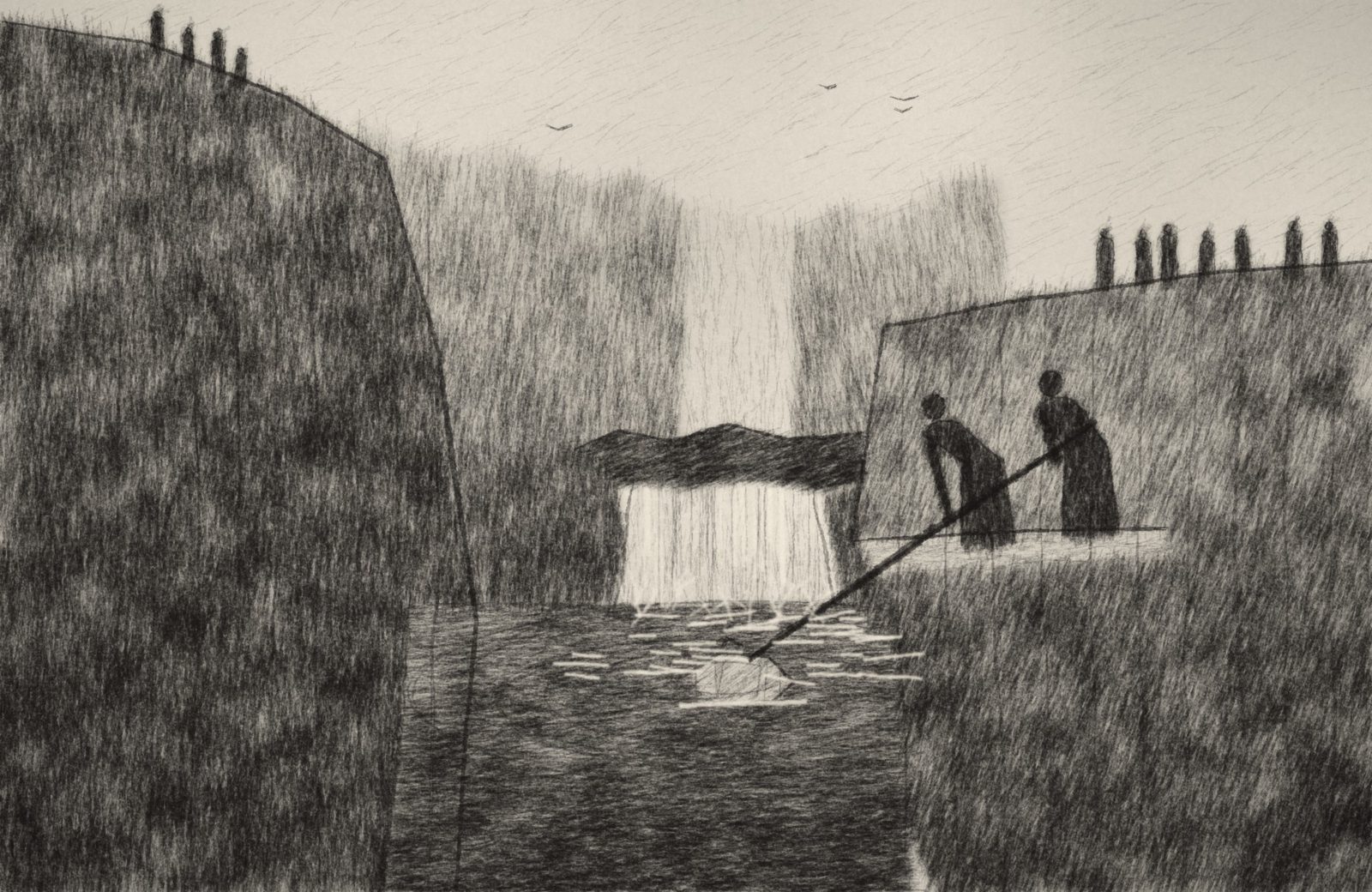
Drekkingarhylur as the records describe it: a woman in a sack, held under with a pole until she stopped struggling, while the assembly watched from the rims of the gorge.
The pool you see is not the pool they saw
Visitors expect a deep, dark pool. What they find is shallow water tumbling over stones. That is not how the women saw it.
Older sources describe a deep pool or whirlpool in front of a narrow rock ledge, with the river dropping over it in a substantial waterfall. In 1897 a timber bridge was laid across the Öxará here. It was replaced by a stone bridge in 1911 and reworked again in 1944. The building work packed stone into and around the pool and largely filled it.
In 2002 two members of the Alþingi proposed restoring Drekkingarhylur toward its old form, and dedicating the work to the memory of the women who died there. The bridge still stands over the pool, and the crowds still stop on it for photographs.
Fire and Rope: Brennugjá and Gálgaklettur
Drekkingarhylur is the execution site everyone has heard of. Two others lie within a short walk of it, and almost nobody stops at either.
Brennugjá, the Chasm of Fire
Brennugjá is a shallow fissure just east of the road that runs down to the Þingvellir farm and church, the same road that crosses Peningagjá, the Money Fissure. Many visitors cross it without noticing. The road crosses the chasm partly on a built-up embankment, and the burning place itself, near the mouth of the fissure, went under that road when it was laid in the early twentieth century.
Iceland’s burning age ran from 1625 to 1685. Across the country 21 men and one woman were burned for sorcery. Nine people were burned at Þingvellir, most of them men convicted of using runes, magical staves or spells. The last burning in Brennugjá took place on 4 July 1685, and that final victim died for blasphemy rather than witchcraft.
The list names eight men burned at the Alþingi between 1667 and 1681. The first, Þórarinn Halldórsson from the Westfjords, was 42. The list gives his place of death as Almannagjá itself, the gorge every visitor walks through. In 1674 two men, Páll Oddsson and Böðvar Þorsteinsson, were burned at the same assembly. In 1677 two more followed: Bjarni Bjarnason, 62, and Þorbjörn Sveinsson, 37.
The annals record doubt even at the time. One man, Lassi Diðriksson, was burned at the Alþingi on a charge some thought nearly baseless. Heavy rain fell on the assembly that day, and the fire went out three times before it took. By one old reckoning, burning a single person to ash consumed twenty horse-loads of brushwood. Human bones have been found in the chasm.
Gálgaklettar, the Gallows Rocks
The English name is usually given as Gallows Rock, singular. The place name is plural: two bare rocks on the east wall of Stekkjargjá, the fissure that continues Almannagjá north-east beyond Öxarárfoss. They stand roughly 400 metres north of the waterfall, beside the old path that led up to Langistígur.
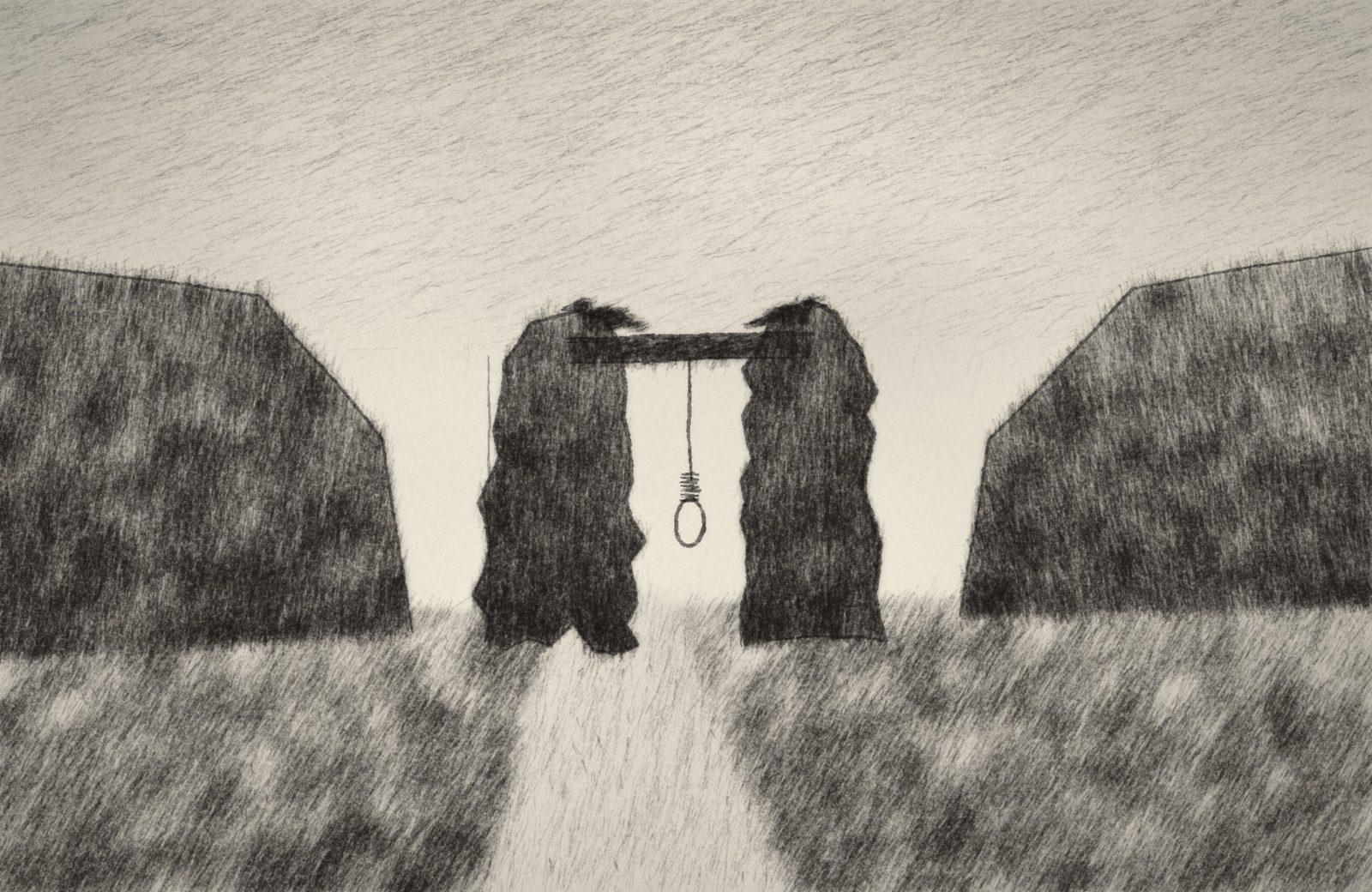
Gálgaklettar: a beam laid between two rocks in Stekkjargjá, with room to hang one person at a time.
There was no gallows frame. A beam was laid across the gap between the two rocks, and the condemned were hanged from it. A nineteenth-century account, taken down from an old Þingvellir priest, judged there was room to hang only one person at a time, perhaps two. Steinunn J. Kristjánsdóttir’s list records 17 hangings at the Alþingi: 16 for theft and one, Þorgeir Ingjaldsson in 1681, for adultery. The thieves included two young men hanged together in 1697, aged 17 and 20. In that era, a single stolen lamb could begin the chain of events that ended here.
The same account records that six or seven skulls were found in a hole at the site shortly before 1830, and that the priest of the day had them moved to the churchyard.
Between Gálgaklettar and Drekkingarhylur lies Öxarárfoss, the most photographed waterfall in the park. Walk from the bridge to the falls and on to the rocks, and you have walked between two execution sites without passing a single sign that says so.
The four sites form a single walk through the rift valley: Drekkingarhylur under the footbridge, Öxarárfoss, Gálgaklettar in Stekkjargjá about 400 metres beyond the falls, and Brennugjá by the road to the Þingvellir church, with Höggstokkseyri in the river below it.
Beyond Þingvellir: The Gljúfrá Case, 1763
After 1752 the axe left Þingvellir, but it did not leave Iceland. One case on Steinunn J. Kristjánsdóttir’s list links to a local history of the farm where it began, written by historian Kjartan Ólafsson from the original court papers. It shows how the system worked in its last decades, step by step.
Gljúfrá is an abandoned farm in Arnarfjörður in the Westfjords, empty since 1943. In 1758 the parish priest recorded an 18-year-old girl there named Ólöf Jónsdóttir. She had been confirmed that year, could read, and knew her catechism. The priest’s entry says she „þénar hjá stjúpföður sínum, Ívari Jónssyni á Gljúfrá, hegðar sér vel og frómlega“: she serves her stepfather, Ívar Jónsson of Gljúfrá, and behaves well and honestly.
A year later her stepfather made her pregnant. The birth was hidden, the child did not survive, and the truth came out.
The sentence
On 16 May 1761, at the local assembly site at Auðkúla, the acting sheriff Sigurður Sigurðsson, nicknamed “Shadow”, and eight local farmers sentenced both to death. The charges were incest, a concealed birth, and failing to try to keep the child alive.
The sentence for Ívar went far beyond beheading. He was to be led to the place of execution with a noose around his neck and pinched three times on the way with glowing tongs. At the block he was to lose his right hand first, then his head. Ólöf was also to be beheaded, and her head set on a stake as a warning to others.
Two years in a cell
The sentence was confirmed at a special assembly at Selárdalur in August 1761. Then the case went to the Supreme Court in Copenhagen, which confirmed it on 16 December 1762. The news did not reach the sheriff until the following summer. Ívar and Ólöf were executed on 22 August 1763, most likely at Auðkúla. They had spent 118 weeks in custody, probably in the sheriff’s own lock-up.
Kjartan Ólafsson concludes that this was almost certainly one of the very last executions in the Westfjords, and the last time blood was shed in Iceland for incest.
When they were led to the block, Ólöf’s mother, Ingibjörg Jónsdóttir, was still running the farm at Gljúfrá, about sixty years old. She had just lost her husband and her daughter to the same sentence.
The same soil, eighty years later
There is a twist in the farm’s later history. By the 1840s part of Gljúfrá belonged to Jón Sigurðsson, an archivist in Copenhagen and the man Icelanders now honour as the leader of their independence movement. Owning that share of Gljúfrá made him eligible to stand when the Alþingi was restored in 1844. The farm where a father and daughter were condemned helped put the country’s most famous politician into its new parliament.
How It Ended
No single person stopped the killing, and no single day ended Stóridómur. It wound down over 180 years, and the power that ended it was the same one that had profited from it: the Danish Crown.
1749 · Last woman drowned at Drekkingarhylur.
1752 · Last execution at Þingvellir: Kjöseyrar-Jón, beheaded for murder.
1760s–1790s · Women condemned at the Alþingi are now sentenced to beheading, not drowning. Death sentences go to the Supreme Court in Copenhagen for review.
1763 · Last known execution for incest in Iceland, at Auðkúla in Arnarfjörður.
Late 1700s · Prison sentences start to replace execution. A prison house is built in Reykjavík; the same building now holds the Prime Minister’s office.
1798 · The Alþingi meets at Þingvellir for the last time.
1830 · Last execution in Iceland: Agnes Magnúsdóttir and Friðrik Sigurðsson, beheaded at Vatnsdalshólar on 12 January.
1830–1869 · About ten more Icelanders are sentenced to death, mostly for sexual offences and hidden births. The king commutes every sentence.
1869 · New penal law, modelled on Danish law, removes the death penalty for incest and for hiding a birth.
1915 · Iceland’s last death sentence is confirmed in Copenhagen, then commuted to prison.
1928 · The death penalty is abolished.
1995 · A constitutional revision makes reinstating it unconstitutional.
Who stopped it
The honest answer is: Copenhagen. The sentences of the early 1600s were carried out at the same Alþingi that passed them, usually immediately or while the assembly was still sitting. By the 1760s, a death sentence had to travel to the Supreme Court in Copenhagen and back, which could take two years, and royal pardons grew more common. Legal historian Páll Sigurðsson credits the softening influence of the Enlightenment in the late 1700s. After 1830, the king commuted every death sentence an Icelandic court passed.
The law itself changed last. The penal law of 1869 finally removed death as the sentence for incest and for hiding a birth, the two crimes that had filled the Drowning Pool. By then nobody had been executed for either in more than a century. The Icelandic parliament abolished the death penalty altogether in 1928.
It Has Not Ended Everywhere
It is tempting to file Stóridómur under a darker age. That age is not over. Amnesty International recorded at least 2,707 executions in 17 countries in 2025, its highest total since 1981, and that figure leaves out China, which keeps its numbers secret. Iran carried out at least 2,159 and Saudi Arabia at least 356. Together they account for 93 percent of the recorded total.
Most of those executions were for drug offences. But Amnesty’s report also records people put to death for blasphemy and for sexual relationships outside marriage. Those are the same two kinds of offence, in modern form, that once filled the gorge at Þingvellir: words against God, and sex the law did not permit.
The parallel is not about one faith. Stóridómur was written by a Lutheran state, and its judges invoked God throughout the text. The pattern is the same wherever it appears: a state that treats private life and belief as crimes and answers them with death. Iceland took two centuries to climb out of it.
More from the archive: Peningagjá, the Money Fissure at Þingvellir · a local history of Gullfoss and the Hvítá · Brúarfoss, the waterfall that was a road · all the Untold Stories of the Golden Circle.
Common Questions
What is Drekkingarhylur? Drekkingarhylur, the Drowning Pool, is a pool in the Öxará river at Þingvellir, under the footbridge where the river leaves Almannagjá. At least 18 women were executed there between 1618 and 1749: each was put into a sack, pushed into the pool and held under with a pole.
Is the Drowning Pool at Öxarárfoss? No. Öxarárfoss is the tall waterfall further up the gorge. Drekkingarhylur lies downstream, at a lower fall under the footbridge. Building the bridges in 1897, 1911 and 1944 largely filled the old pool, so the water there today is shallow.
How many people were executed at Þingvellir? Legal historian Páll Sigurðsson counts 72 executions there between 1602 and 1752. Archaeologist Steinunn J. Kristjánsdóttir’s list names 75 people executed at the Alþingi: 55 men and 20 women. It records 21 beheadings, 17 hangings, 17 drownings and 8 burnings, and does not say how the other 12 died.
Were the women drowned at Þingvellir accused of witchcraft? No. They were drowned for incest, adultery, perjury or hiding a birth after which the child died. Iceland burned its convicted sorcerers, and all but one of those burned were men.
What was Stóridómur? Stóridómur, the Great Judgment, was a law on sexual offences passed by the Alþingi on 30 June 1564 and confirmed by King Frederick II the following year. It made sex within seventeen degrees of kinship and marriage a capital crime, with men beheaded and women drowned, and set fines and floggings for lesser offences.
Where are the execution sites at Þingvellir? Drekkingarhylur is under the footbridge over the Öxará in Almannagjá. Gálgaklettar, where thieves were hanged, are two rocks in Stekkjargjá about 400 metres north of Öxarárfoss. Brennugjá, where people were burned, is a shallow fissure by the road to the Þingvellir church, and Höggstokkseyri, where the block stood, was a gravel bank in the river below it.
When did executions end in Iceland? The last woman was drowned at Þingvellir in 1749 and the last execution there was in 1752. The last execution in Iceland took place on 12 January 1830. The 1869 penal law removed the death penalty for incest and hidden births, and Iceland abolished the death penalty in 1928.
Sources
Steinunn J. Kristjánsdóttir, list of executions in Iceland 1550–1830, University of Iceland. The roll of 75 executions at the Alþingi, with ages, home districts, crimes and methods, each traced to the annals and the Alþingisbækur.
Þjóðskjalasafn Íslands (National Archives of Iceland), Stóridómur: transcription of the 1564 judgment from a copy written around 1635, with commentary. The judges, the date, the wording of the penalties, the fines and the king’s revenue.
Páll Sigurðsson, “Aftökuörnefni”, Árnastofnun, 2019, from a lecture given on 26 February 2011. The count of 72 executions, the method of drowning, Gálgaklettar, Höggstokkseyri, Brennugjá and the Enlightenment.
Þjóðgarðurinn á Þingvöllum (Þingvellir National Park), place-name entries for Drekkingarhylur and Brennugjá. The first and last drownings, the bridges of 1897, 1911 and 1944, the nine burned at Þingvellir and Lassi Diðriksson.
Alþingi, proposal for a parliamentary resolution on restoring Drekkingarhylur in Almannagjá, 127th session, 2001–2002. The original pool and fall, the haircloth sack and the bridge works.
Vísir, “Öll þessi andlit í Drekkingarhyl”, drawing on an article by Steinunn J. Kristjánsdóttir. Þórdís Halldórsdóttir and the fingraklemma.
Kjartan Ólafsson, “Gljúfrá”, a local history of the farm from the original court papers. The case of 1761–1763.
Morgunblaðið, “Þar rauður loginn brann”. The last burning in Brennugjá, 4 July 1685.
Vísindavefurinn, “Hvenær var síðasta aftakan á Íslandi?”. The last executions, the pardons after 1830, the 1869 law and abolition in 1928.
Amnesty International, Death Sentences and Executions 2025, as summarised by the Death Penalty Information Center. Executions worldwide.
The illustrations are charcoal-style reconstructions made for this article. They interpret the written record and are not historical images.